Tuesday, 23 June 2015

An Article On 'Father's Day' from the Language Department !!!!

          
   పితృదినోత్సవం
      పితృదినోత్సవం , మాతృదినోత్సవం  జరుపుకోవటం మన సంస్కృతి కాకపోయినా  మన జీవితాలలో నాన్న పాత్ర ఎంతో ముఖ్యమైనది . అందుకనే ఈ రోజున నా మనసులోని భావాలను మీతో పంచుకోవాలనుకుంటున్నాను .
     చరిత్రను చూస్తే కొంతమంది జీవితగమ్యాలను నిర్దేశించటం లో తండ్రుల పాత్ర ప్రముఖంగా కన్పిస్తుంది . ఉదాహరణకు మన ప్రధాని శ్రీమతి ఇందిరాగాంధి . తండ్రి జవాహర్లాల్ నెహ్రూ గారు రాసిన లేఖలు ఆమెకు ఎన్నో విషయాలలో మార్గదర్శకమయ్యాయి . అంతెందుకు మన ఓపెన్ మైండ్స్   పాఠశాల స్థాపనకు కూడా మూలం తమ తండ్రి శ్రీ సుధాకర రెడ్డి గారి ఆశయమేనని,  మన  డైరెక్టర్ శ్రీమతి షర్మిల గారు చెప్పారు.
    అంతెందుకు  చిన్నప్పుడు  ఒక్కొక్కసారి అమ్మ వద్దు అని చెప్పిన కూడా , మనం కావాలి అని అడిగినవి తెచ్చి ఇచ్చింది  నాన్నెకదా ! ఇలాంటివి మన0దరి జీవితాల్లో తీపి జ్ఞాపకాలుగా
వుంటాయి.
      ఈ సందర్భంలో నేను మా నాన్న గారి మాటలు గుర్తు చేసుకుంటూ వుంటాను. మనం పని చేసే చోట ఎంతో నిజాయితీ గా వుండాలి. క్రమశిక్షణగా వుండాలి. మన అసంతృప్తి ,వ్యక్తిగత   సమస్యలు పనిలో చూపించకూడదు .అని చెప్తువుండేవారు.ఆ మాటలని ఆచరించటానికి నేను ప్రయత్నిస్తూ వుంటాను.
     ఒక ఉపాధ్యాయినిగా నేను ఎంతో మంది తండ్రులను చూశాను. వారి కళ్ళల్లో వారి పిల్లల పట్ల కనిపించే అనురాగం, తమ పిల్లలు ప్రపంచం లో అందరి కన్నా గొప్పవారిగా అవ్వాలి అనే ఆశ   చూశాను.
     మారుతున్న ఈ కాలంలో తల్లులతో పాటు తండ్రులు కూడా పిల్లల బాగోగులు పట్టించుకోవలసివస్తోంది. వారికై  ఎక్కువ సమయం  కేటాయించవలసి వస్తోంది.
      సహజంగా ఆడపిల్లలను  నాన్నకూచి  అంటువుంటారు. ఉమ్మడి కుటుంబాలు తగ్గిపోయి,ఒక్కరిద్దరు పిల్లలే వుంటున్న ఈ రోజుల్లో ఆడపిల్లలే తల్లి తండ్రుల బాధ్యత
తీసుకుంటున్నారు.
       మన ముద్దుమురిపాలను  తీర్చి, మన భవిష్యత్తును తీర్చిదిద్దటానికి  పాటుపడే నాన్నకు జేజేలు చెపుదాం. ముసలితనంలో  అమ్మానాన్నలకు  అండగా నిలుద్దాం. వారికి ఆనందాన్ని కలిగిద్దాం.
                   నాన్నా!!  ఓ నాన్నా!!
                   నీవు అందరికన్నా ఎంతో  మిన్న
                   నీవు  దిద్దించిన ఓనమాలు
                  నేర్పించాయి ఎన్నో పాఠాలు
                  నాపై నీకున్న పేక్ష          ( పిల్లల శ్రేయస్సుకై శ్రమించే  ప్రతి  తండ్రికి  
                  నా జీవితానికి శ్రీరామరక్ష       నమస్సుమాంజలులతో,)
                  గుర్తుంచుకుంటాను నీ మాట                        -విజయలక్ష్మి
                  వేసుకుంటాను నా జీవితానికి పూలబాట           తెలుగు ఉపాధ్యాయిని.

                 నీ కండదండగా వుంటాను ప్రతిచోట.

Sunday, 21 June 2015

MOTHER wrote about her SON'S emotions !!!


A MOTHER wrote about her son's emotions and tiredness from starting primary school for the first time, and meeting his need for attention at the end of a long school day.....................


It’s several weeks into the school year and my little son is experiencing his share of ups and downs adjusting to life at ‘big school’

He waves me happily off each morning, and the beautiful hug he gives me every afternoon on the reunion at the school gate.  Seeing my independent, confident, happy little boy embrace this new stage of his life fills me pride. 

He talks animatedly about the new friends he is making, his “best friend at school” – and the fun and challenging things he is doing in the classroom.

But then there are the difficult moments. Starting primary school - such a big life change, has also come with its fair share of big emotions for my sensitive boy. After trying so hard to concentrate and control his impulses all day, those emotions often came home looking for an outlet. Any small thing has the potential to set him off -  from running out of his favourite snack to losing a pencil lid - and from this small inconvenience a large meltdown often take issues. 

For a while I was at a loss about how to handle this. I wanted to try and understand where he was coming from but also be firm about expected appropriate behaviour – slamming the door and telling me he hates me were deal breakers. I also wondered what I could do to  prevent the meltdowns before they happened, but in some ways it seemed they were unavoidable events – he was looking for a reason to just blow off steam. I tried talking to him, explaining, ignoring, comforting – nothing seemed to be working.

After one particular session of him shouting at me while I was trying to cook dinner, I shouted back at him in frustration, which had sent him running to his room and left me feeling awful.
On another day, after sending him to his room to calm down for the third time in as many days, he implored me not to leave him there. “This is not teaching me anything!” he shouted, “I don’t want you to leave me here alone!” I sighed and asked “Okay, what is going to help you right now? What do you need? Do you need a cuddle?” He cried and said yes, so I sat on the bed and cuddled my big boy (who is really not so very big) while he sobbed his little heart out for several minutes.

All the tensions of the day came flooding out with his tears. When he had calmed down a bit, I focused on empathy - I spoke to him gently and said that I know he is working very hard each day to sit still in class and concentrate on what the teacher is saying, and I know that takes a lot of effort. I told him it’s okay to be angry, and it’s okay to cry, but it’s not okay to slam doors and to say you hate me. His response: “I don’t really hate you mum I’m just saying that so you will know that I am angry.”  I told him I know he doesn’t hate me and I also know that he is angry - he doesn’t need to shout and scream for me to understand that. That’s when he said something that really clicked for me. “But when I’m talking to you, you are doing other things and not listening properly and so I have to scream and shout.”This is when I realised that, often when he comes home from school, I will be listening to him while I am attending other activities. But from my son's point of view, if I am not giving him my full attention I am not listening at all, and so a small frustration takes on huge proportions.

What I think he was telling me is that after a full day at school he needs my undivided attention for a certain length of time to regain his equilibrium. I am sure the other factors – tiredness, learning how to control his impulses – still apply, but since that discussion I have made a concerted effort to just sit with him for 15 minutes when we get home, and listen, cuddle or play. Everything else has to wait.  It was by listening to my five-year-old that I was reminded of the simple truth that small changes can make a big impact.


A Mother.


Saturday, 20 June 2015

Happiness Week: 15th – 19th June 2015, Theme: Discipline - Culmination Report

Dear Parents,

The first Happiness Week of this academic session ends today and we did have a good learning of the topic ‘Discipline’. All the students were spoken to in detail about why ‘Discipline’ is so important in life and in our day-day activities. It was wonderful to see the students of Grade 1, who did not know the word ‘Discipline’, now understand how important it is to behave well.

The middle school students even came up with instances where they felt they were not so well behaved last year, and have now committed to work on the same and exhibit more coordination with others. There has been a significant change in how they were ready to take up more responsibility.

The ‘Buddy System’ is now in place and the list has been shared with the students as to which team they would belong to. A teacher will head each team so that there is a constant monitoring of how this system is working. The final list will be shared with all the students on Monday.

The best execution of the idea came up when the entire Student Committee was being formed this week. The senior students nominated themselves for the committee and campaigned for votes. It was a tough competition and was wonderful to see how each of them had an agenda and ‘good behavior’ topped the lists!

It was the ‘Election Day’ for the student committee and all the students from Grade 1-9 had an experience of a real-time voting system. All these activities being lined up in the same week gave the students more inclination towards understanding ‘Discipline’ and its importance to the core.
Will come up with another interesting theme and learning for the next month. Once again, we thank all our parents for the continued faith and support in us!


With best regards,
Ms.Swapnali Deore

Principal

Thursday, 18 June 2015

Precious Parent’ workshop series, 20th June, 2015

From the Desk of:
Ms. Padmaja, Life Coach,
Open Minds, A Birla School


As we start our new session and are settling in, we look forward to meeting with you for our first session of the ‘Precious Parent’ workshop series. 
It would be an interactive workshop where we are all together trying to find the best of ourselves for our children.


It would be a 2.5hr session starting from 
10am - 12:30pm on 20th June, Saturday. The workshop is being conducted by me.
Do message us on +91 7660973334 for confirming your presence latest by 12pm on Friday 19th June.

Join us and help us build a healthy community for our children!

Tuesday, 16 June 2015

Don't Chase Your Happiness - Let it Land on You

From the Desk of:
Arup Sinha,
Academic Coordinator,
Open Minds, A Birla School.

                       It was a little difficult for me to compose a blog-post mainly about happiness because I don’t believe in chasing it. But happiness is just one of many rich feelings that give me, and I think most people, a feeling of humanity and a sense of living a full and meaningful life. 
When happiness is absent in our daily lives or is fleeting, that’s a sign that something is more seriously wrong – and it’s the time to get support from experts,  not the time to chase happiness. Because if you run after happiness you may never catch it.
Happiness lands on you when you are in the right place, doing the right thing, with the right people, pursuing the right goals – ‘right’, because it’s right for you.  Tal Ben-Shahar, a Harvard Professor expresses it best with one piece of advice “Give yourself permission to be human : When we accept emotions - such as fear, sadness, or anxiety - as natural, we are more likely to overcome them. Rejecting our emotions, positive or negative, leads to frustration and unhappiness. ”  I’ll get back to Ben-Shahar in a moment, because it’s worth using his advice if you want happiness to land on you more often. But for now, let me give you one example from a household with children:


  You are tired, you’re grumpy, you don’t feel like reading a book to your child before he goes to bed.  Telling yourself “Reading is important, you should love this time with your child, reading is fabulous, smile and carry on”  will probably just exhaust you, and you’ll be no happier. Accepting and noticing that you are more tired than usual and offering to play a simple game instead, or look at picture books together, or watch a favourite television show, will probably leave you feeling more relaxed – you can read a book tomorrow.


Our Telugu teacher Vijaya Lakshmi ma'am

You might or might not be aware, but we have a wonderful Telugu teacher in our school - Vijaya Lakshmi ma'am! She is probably the kindest Telugu teacher ever. She is very passionate about her subject and enjoys teaching our students. She has recently met with an accident where she fractured her hand but she continues teaching with all her might and is known to always encourage students to express them selves.

Her classes are interesting and she often incorporates activities to make it fun. Here are some pictures from the recent classes:


Grade 6 students, Shishir and Anek, were recently doing a role play of a great Telugu writer, Sri Madhurantakam Rajaram, Jarina Gunde.


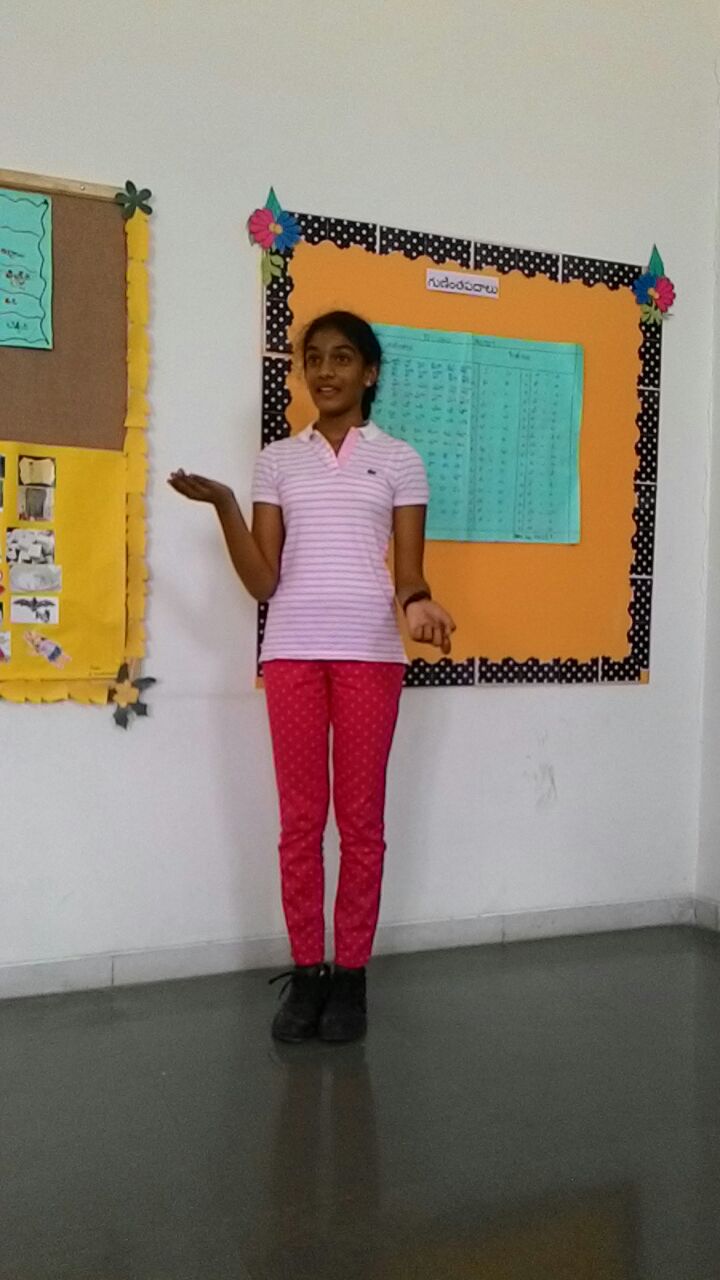
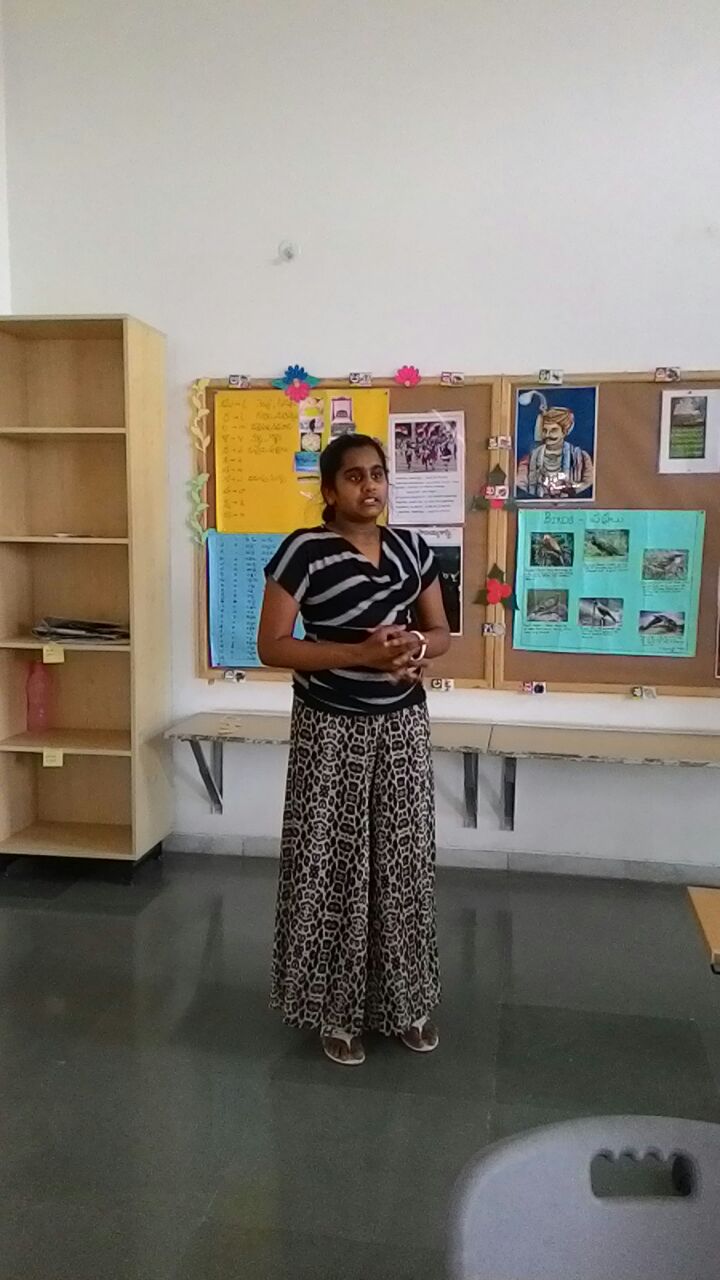
Grade 8 students: Krithi, Adhya, Guneet, Sanjana and Rithvik have practiced elocution in the Telugu class. Yes, in Telugu language, of course! Vijaya Lakshmi ma'am wouldn't have it any other way!


Krithi

Adhya

Guneet

Sanjana


Rithvik


Monday, 15 June 2015

How about bullying?

Bullying is an unwanted, aggressive behavior among school aged children that involves a real or perceived superiority of power. Bullying can take many forms, such as hitting, kicking, threatening others, teasing, name-calling, excluding from a group, or sending mean notes or e-mails. A child who is being bullied has a hard time defending him or herself. Often, children are bullied not just once or twice but over and over.


Bullying is very common during the elementary and middle school years especially between grades 4 and 8. Perhaps the attitude that bullying is part of growing up is what that makes the practice still common in all Indian schools. There is a lot of research that shows that being a victim of a bully can affect students’self-esteem and how they approach school. It is the victims of bullying who often report that they do not want to go to school because of fear of being bullied. Some children who are bullied decide, in turn, to bully others. For all of these reasons, it is important that schools address the bullying problem in their school.
Most bullying happens at school and on the school bus to and from school. Bullying also can take place when kids walk to andfrom school.Bullying is more likely to happen when large groups of students are supervised by a small number of adults, including during lunchtime, recess, physical education, and during transition times. Students also report being bullied in the classroom when their teacher’s attention is diverted.
Both boys and girls bully but there is some interesting differences in the way they bully. Boys tend to be bullied by other boys, whereas girls are bullied both by boys and girls. The most common form of bullying for both boys and girls is verbal bullying (teasing, name-calling). Boys are more likely to say that they are physically bullied. Girls are more likely to report being targets of rumour-spreading and sexual comments. Both boys and girls engage in what is called relational aggression. Individuals who use relational aggression tend to exclude students from a group,or they might threaten to not be someone’s friend unless he/she does what they say. Girls are somewhat more likely than boys, to bully each other through social isolation.
Bullying often involves groups of students picking on another student. Within these groups, there often is a “ring leader”and a number of followers. In addition, many students observe bullying but do not necessarily take any action—they neither engage in the bullying nor help stop the bullying. Children and youth are often reluctant to try to stop bullying because they are afraid of being bullied themselves, because the want to be part of a popular group, or because they simply are not sure how to help.
There are many factors within a child’s environment that can contribute to bullying behavior. Students who bully are more likely to witness violence in their home, have little parental supervision and lack warmth and involvement by their parents. Children who bully also are likely to “hang out” with others who bully and feel that they gain their popularity or “coolness” by teasing other students. Bullying thrives in schools where faculty and staff do not address bullying, where there is no policy against bullying and where there is little supervision of students—especially during lunch, bio-breaks. Negative models of bullying behavior are also prevalent throughout society—especially in television, movies and video games.


What can be done to reduce bullying in school?

The good news is that much can be done to stop bullying in our schools. A single school assembly, PTA meeting, or social studies lesson on bullying won’t solve the problem, however. What is needed is a team effort by students, teachers, administrators, parents and other staff to change the culture, or climate of schools. Many schools are meeting this challenge.

S.Chandra

CBSE Coordinator at Open Minds